Increasing planning fees and performance: technical consultation

Introduction

As part of their continued ‘levelling up’ agenda, the Government has launched a consultation on new plans to annually adjust planning application fees in line with inflation, with an initial increase of between 25% and 35% being earmarked as early as this Summer in England. Extra funds raised by the fee hikes are to be ring-fenced for local planning authorities to provide a more effective service through additional financing and resources.

The Government says the proposed changes have come as a result of consistent feedback among many businesses and individuals involved in the planning process that the core planning application service is not consistently performing at the level it should be.

Planning Application Fees

The following amendments to planning fees are proposed by the consultation:

-An increase in planning fees for major applications by 35%

-An increase in planning fees for all other applications including prior approvals by 25%

-Double fees for retrospective applications (except for householders)

-Removal of the ‘free-go’ for repeat applications

Therefore, with the proposed 25% increase, householder planning application fees would rise by £52, from £206 to £258 while, prior approval applications would rise from £96 to £120.

Non-major applications, which are charged per dwelling or per 75 square metres of non-residential floorspace, would rise from £462 to £578.

As a result of the 35% increase in major planning application fees, major applications for between ten and 50 dwellings or between 1,000 and 3,750 square metres of commercial non-residential floorspace will rise from £462 to £624 per dwelling or per 75 square metres.

Major applications for over 50 dwellings or more than 3,750 square metres of floorspace would be charged at a rate of £30,860 plus £186 for each additional dwelling in excess of 50 dwellings or additional 75 square metres in excess of 3,750 square metres up to a maximum of £405,000. Applicants are currently charged £22,859 plus £138 for each additional dwelling in excess of 50 dwellings or additional 75 square metres in excess of 3,750 square metres up to a maximum of £300,000. The current proposals offer a considerable uplift in the maximum fees for major applications.

Having not increased since January 2018, the Government has announced that to keep up with inflation, it is proposed that planning application fees will be adjusted annually. The proposed changes would apply to all applicants, notwithstanding those able to claim fee exemptions. The Government estimate that the proposed increase will represent on average, less than 1% of overall development costs incurred by applicants.

Local Planning Authority Capacity and Capability

The Government has estimated a funding shortfall for the planning application service, which is currently estimated to be in the region of £225 million annually (approximately 33%). They emphasise a desire to reduce the funding shortfall and create greater financial sustainability for all local planning authorities, whilst also wanting local planning authorities to be more efficient, to lower the costs of delivering the planning application service.

In relation to the performance of the planning applications service, the Government state that they want to ensure all applicants experience a high-quality and timely service. The consultation therefore proposes a new approach to how the performance of local planning authorities is measured across a broader set of quantitative and qualitative measures.

The Government highlights that whilst extension of time agreements are useful, they should be used in exceptional circumstances to allow additional time for unforeseen issues to be resolved to the benefit of all parties. Currently, extension of time agreements do not count against a local planning authority’s performance figures for speed of decision-making and therefore can mask instances where local planning authorities are not determining applications within the required statutory periods. Although not specifically mentioned in relation to extension of time agreements, the Government propose the introduction of a wider range of metrics to encourage improvements in service quality, which in doing so, will allow the Government to identify authorities that are most in need of additional targeted support.

Specific metrics have not yet been outlined within the consultation, however It is proposed that a broadened planning performance framework would continue to focus on development management activity only and would exist alongside other performance monitoring regimes, for example in relation to local plan progress.

Potential Introduction of ‘Fast Track’ Applications

In addition to statutory planning application fees, local planning authorities have the ability to charge for bespoke or additional services above the level or standard that the local planning authority has a duty to provide, provided that these charges do not exceed the cost of providing the service. These services can include pre-application advice, Planning Performance Agreements (as currently exist), and the consultation identifies the prospect of premium or ‘fast track’ planning application services. More broadly, the consultation identifies that the Government has shown interest in expanding the options available to local planning authorities including allowing extra flexibility to bespoke services where these services would provide a more expedited service.

No specific changes are proposed within the consultation however the Government are seeking to understand what experiences stakeholders have had regarding bespoke or ‘fast track’ services for which an additional fee is or could be charged and how this has assisted in supporting faster decision-making. They also welcome any other suggestions on how local planning authorities could deliver a more efficient planning application service for an additional fee.

Tightening the Planning Guarantee

The Planning Guarantee allows for an applicant to secure a refund of the planning fee where a planning decision has not been made within 26 weeks of submitting a valid application if an extension of time has not been agreed with an applicant.

The consultation proposes that where the statutory determination period is 8 weeks the Planning Guarantee should be set at 16 weeks and where the statutory determination period is 13 weeks (or 16 weeks for Environmental Impact Assessment developments) the Planning Guarantee should be retained at 26 weeks.

Introduction of a Prior Approval Fee for Permitted Development Rights Afforded to the Crown by a Closed Defence Site

A further proposal seeks to introduce a prior approval fee for the permitted development right allowing development by the Crown on a closed defence site. For context, in December 2021 the Government introduced a new permitted development right allowing development by the Crown on a closed defence site under Class TA of Part 19 of the Town and Country Planning (General Permitted Development) (England) Order 2015, as amended. The right allows the Ministry of Defence to both extend and alter existing buildings and erect new buildings within the perimeter of a site, subject to certain limitations and conditions.

Conclusion

The proposals seek to ringfence planning fee income for the running of planning departments however this only relates to the uplifted portion of the fees with the original portion of the fee remaining available for use across any local authority function. If the Government really wanted to invest in the planning application service, all fees received from planning applications should be used to cover the costs of the service, with any additional profit being released for wider use by local authorities.

The removal of the ‘free go’ for non-householder applications is likely to provide particular concern for some small and medium enterprises who would be required to completely restart the planning process should an application be refused or withdrawn. The Government has consistently stated that they wish to support the growth of smaller businesses, however the initial costs incurred through planning could be a cause for concern. It would be more appropriate for the Government to implement a reduced planning fee in these instances to ensure consistency in their aims to support new and existing small and medium enterprises.

The proposals are undoubtedly welcomed on the whole provided that the uplift in fees will result in a tangible improvement to the planning application experience and the overall efficiency of the services provided by local planning authorities through the recruitment and training of staff.

Whilst the proposals have been earmarked for introduction this summer, they remain at consultation stage, and are likely to be subject to change as a result of the outcome of this process.

The consultation will last for 8 weeks from 28 February 2023 to 25 April 2023 and is accessible online via this link


Article by Will Hayes

Firstplan Welcomes New Addition To the Team and Announces Promotions

Introducing Ashkan Liaghat as the latest addition to the Firstplan team. Ash joins us as an Associate, bringing with him experience from both the public and private sectors. Ash has extensive experience across industrial, commercial, residential, mixed-use, life-science and educational development projects.

Firstplan also celebrates the well-deserved promotions of Amy Murray to Planner, and Rory Coles and Joshua Hindle to Assistant Planner.

It’s fantastic to see the continued growth of the team as Firstplan expands its client base and instructions, whilst also recognising the value of current team members to the company’s longstanding success.

Head over to our Team webpage to meet the Firstplan team in full.


Firstplan 2022 Wrapped

As the year draws to a close, Firstplan would like to thank all our clients for a great 12 months of instructions. Working up and down the country across a broad range of sectors, our Directors and team continue to provide strategic advice and support to key names in property and industry, whilst also forging successful connections with new clients.

In 2022, Firstplanners gave back to the local community by volunteering at the Age UK Yalding Day Centre in south-east London, a local charity that both empowers and supports elderly residents in and around Bermondsey. The company also enjoyed taking part in the Great British Beach Clean 2022 on the Isle of Sheppey in Kent.

Whilst the past year has seen much political turmoil, including three Prime Ministers, and three Secretaries of State for Levelling Up, Housing and Communities, culminating in the return of Michael Gove, we still await the Levelling Up and Regeneration Bill, with a shake-up expected in housing targets, and the introduction of a new Infrastructure Levy. The Growth Plan 2022 from the previous Chancellor, Kwasi Kwarteng, signalled intentions to speed up decision taking, and final secondary legislation is still outstanding for Biodiversity Net Gain, which is expected to become mandatory from November 2023. Positive planning legislation updates include the extension of Temporary Pavement Licences provisions up to September 2023, with the provisions expected to be made permanent in Spring 2023. Firstplan will continue to monitor these developments closely in the New Year and will keep our clients informed via our website and social media channels.

The Firstplan family welcomed new members to our team and we continued to increase our year-on-year number of instructions, with particular achievements this year including:

Retail and Town Centres

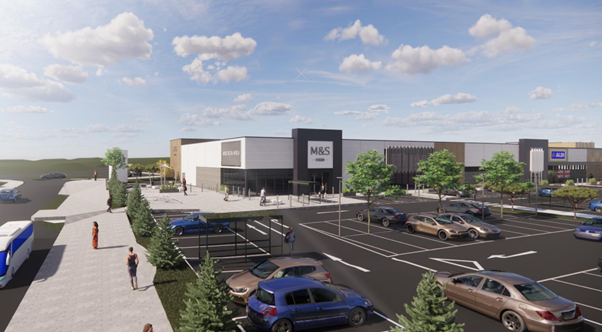
Firstplan were pleased to secure permission for a new commercial district centre in Derriford, Plymouth earlier in the year. The mixed-use, foodstore-led scheme will act as a catalyst for significant investment and regeneration into this area, supporting the sustainable growth and development of northern Plymouth as sought by the Council’s Local Plan.

Working with Bracknell Forest Council, Firstplan provided a retail planning support to the Council at the examination the Council’s new Local Plan. Our strategic advice and support also included commenting on current vacancy levels and undertaking a ‘critical friend’ review of the submission Local Plan retail and town centre policies.

Derriford District Centre

Employment and Logistics

Firstplan played a crucial role in the refurbishment and rebranding of a 1980’s office building into a high quality, flexible 21st Century office campus in Southwark.

Working closely with the Port of London Authority, Environment Agency and Gravesham Borough Council, Firstplan secured planning permission for a comprehensive scheme of works to upgrade and secure the long term continued operation of an important transhipment facility in the Thames Estuary, Tower Wharf.

Our team is also proud to have secured permission for the redevelopment of former industrial buildings into a high-quality office development providing 2,600 sq m office floorspace in Camden.

Firstplan secured planning permission for the expansion of the existing StantonPrecast Ltd site in Ilkeston, Derbyshire to provide a new 9,000 sqm precast concrete segment production facility, along with around 10ha of open storage, a concrete batching plant and ancillary offices and HGV parking.

Firstplan has supported a range of clients in bringing forward rail and wharf based development including a new international car-carrying service at Toton Sidings, Nottinghamshire running between the UK and France and a substantial cement distribution facility at the Port of Sheerness.

Tower Wharf, Gravesham. Images credit: Marjoram Architects

Restaurant and Food Delivery

Firstplan continue to assist some of the restaurant sector’s leading names, including Five Guys, Nando’s, Burger King, Popeyes and Deliveroo. 2022 has seen a significant increase in the demand for drive-thru restaurants. Working with several of our clients, Firstplan has secured permission for various new-build drive-thru restaurants and the adaption of existing restaurants to provide a drive-thru lane across the country.

We have also seen an increase in the opening of high street sites with many restaurateurs making use of the benefits of Class E and the flexibility for buildings to change uses without the need for planning permission.

Earlier in the year, Firstplan assisted in winning an appeal of behalf of Deliveroo, to allow for the continued operation of Deliveroo Editions commercial kitchens in Islington. Following a public inquiry, the inspector concluded that the change of use was acceptable in planning policy terms, as well as having significant economic benefits.

Firstplan were also involved in securing various planning permissions and listed building consents for the amalgamation and change of use of two ground floor units and associated works to a vaulted basement at the Grade I Listed The Royal Exchange in the City of London, to create a vibrant new restaurant and bar: The Libertine.

The Royal Exchange

Hotel and Leisure

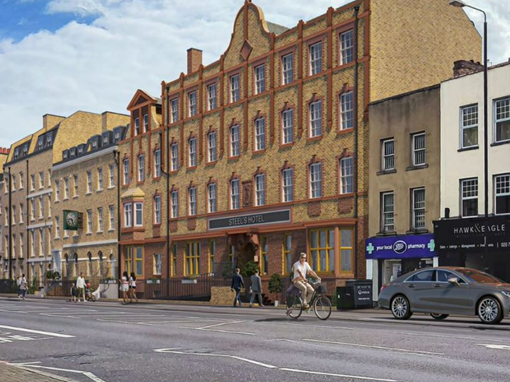
Working for Ziser London, Firstplan obtained planning and listed building consent for the redevelopment of the former Steels Lane Health Centre, parts of which are Grade II Listed, to deliver a 101-bed boutique hotel. The previous NHS Health Centre in Tower Hamlets subsequently became surplus to NHS requirements, rendering it available for redevelopment. Firstplan successfully secured the change of use, extension and internal alterations to the existing building to revitalise the vacant site.

Firstplan are also involved in the redevelopment of the former Hammersmith Magistrates Court to provide a part ten, part five storey building offering 400 hotel rooms.

In Westminster, Firstplan are instructed by Cheyne Capital to provide planning advice for the redevelopment of the Taxi House site along the Grand Union Canal. This project will deliver 332 hotel rooms across 12 storeys along with flexible working spaces, retail, leisure facilities and replacement Westminster City Council cleaning facilities.

Firstplan has also taken a central role in securing planning and lawful development certificates for largescale music festivals and family events at Crystal Palace Park and Gunnersbury Park in London. These temporary events will help secure the long-term upkeep of these listed parks and are an important social lifeline following the Covid pandemic.

Steels Lane Health Centre

Residential

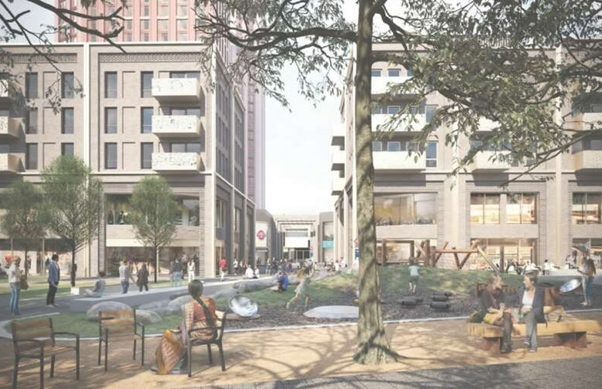
Highlights within the residential sector include our involvement in the redevelopment of The Mall in Walthamstow town centre, east London, comprising two buildings ranging from 24 and 36 storeys to provide over 500 residential units along with retail and community uses. Firstplan’s ongoing involvement includes coordinating a consultant team in preparing technical documentation and leading negotiations with the Council Officers in the planning, economic development and S106 teams to secure permissions.

As part of our continued support to Dominvs Group, Firstplan are involved in delivering a 17-storey building with 713 student accommodation units along with public realm areas and ancillary development associated with the Former Hammersmith Court redevelopment in Hammersmith, west London.

We continued to work with London Borough of Newham, securing consent for 81 affordable homes and a replacement gym in Manor Park and 32 affordable homes in Plaistow.  We have also appraised a further 11 sites for them as they look to bring forward new affordable homes throughout the Borough.

The Mall Redevelopment

Community

Firstplan are proud to have played a crucial role in securing planning permission for one of Veronica Ryan MBE’s Turner Prize-winning works, a monument to the Windrush Generation in Hackney town centre, east London.

Firstplan has also continued to work on many new children’s nurseries across London and the Southeast.

Turner Prize 2022 Winner: Hackney Windrush Art Commission

Whilst we look ahead to 2023 and celebrating Firstplan’s 20th birthday, we would once again like to thank our clients for another successful year.

Merry Christmas from all of us at


Article by Claire Stafford


Nail Bar Use now considered to fall within Class E

Firstplan is delighted to have won an appeal to allow the continued operation of a nail bar with ancillary retail, café and bar uses in Islington.  The Inspector came to the view that the use did not conflict with Islington Local Plan policies seeking to protect Former Class A1 uses, and agreed that the use positively contributes to the vitality, viability and vibrancy of the town centre.

Significantly, the Inspector concluded that ‘a nail bar falls within Class E(c)(iii)’, recognising that nail bars have ‘clearly become a well-established feature of modern high streets’. The nail bar use was found to align with the purpose of the Use Classes overhaul in September 2020, which aimed to ‘better reflect the diversity of uses found on high streets and in town centres and to provide the flexibility for businesses to adapt and diversify to meet changing demands’.  Nail bars had previously mainly been classified as sui generis uses so this change will provide greater opportunity for this type of use.

We are now seeing the impact of the introduction of Class E in appeal decisions. For example, the Inspector took into consideration the potential impacts of high-street retail units changing to other non-retail uses within Class E (such as financial services or gyms) without the requirement for planning permission, balancing this against policies seeking to maintain the retail functions of high streets and town centres.

We look forward to continuing our work with clients relating to Class E uses, and its unfolding impacts on our high streets. If you have any questions on Class E uses, or are seeking advice on an enforcement notice, please get in touch with the Firstplan team.

Consultation on Biodiversity Net Gain (BNG)

In November last year, we posted about the Environment Act 2021, which passed into law on 9th November 2021. One of the key components of the Act is the requirement for Biodiversity Net Gain (BNG): an obligation for developers to ensure new proposals feature at least a 10% improvement to biodiversity.

This week, DEFRA launched a consultation on BNG Regulations and Implementation. The consultation sets out DEFRA’s proposals and asks questions on how the requirement for BNG will be applied to developments and Nationally Significant Infrastructure Projects. The public consultation is described by Natural England as “the turning point in defining the direction for the secondary legislation and guidance to come.”

The consultation seeks views on the detail of how BNG should be delivered – details which will have significant implications for developers and landowners going forward.

Of note, the consultation document proposes exemptions from mandatory BNG for:

– Developments impacting habitat areas below a ‘de minimis’ threshold;
– Householder applications; and
– Change of use applications.

The consultation also considers whether exemptions should be made for the creation of biodiversity gain sites and self-build and custom housebuilding.

The following exemptions are now no longer proposed:

– Brownfield sites which meet set criteria;
– Temporary permissions; and
– Developments where permitted development rights do not apply due to their location in conservation areas or national parks.

Regarding small sites, the Government intend to pursue options for a simplified biodiversity metric to ensure that they can improve ecological outcomes with minimal burdens. It is also confirmed that a lower percentage gain would be inappropriate for small sites.

Furthermore, applications for outline planning permission and phased development will have additional requirements for BNG information to be submitted with the application, which will be set out in secondary legislation. Applicants will be required to explain the strategy to achieve the BNG objective across the whole site and demonstrate how this could be delivered in phases.

Details of the consultation can be found at the link below. If you have any queries, please feel free to contact us.

https://www.gov.uk/government/news/protecting-and-enhancing-the-environment-to-be-at-the-heart-of-new-housing-and-infrastructure-developments


Class F: The Forgotten Class

Since changes were made to the Use Classes Order in September 2020, discussion has largely focused on the impact of the new Class E on our town centres and retail destinations.  Class E wraps up the majority of commercial, business and service uses into one all-encompassing ‘commercial class’ allowing unprecedented flexibility between uses and potentially benefiting around 1.5 million buildings.   These newly introduced Class E freedoms have understandably captured the headlines over the last year.  In contrast, Class F – Local Community and Learning is sometimes overlooked, despite the class including some of our most important community uses and institutions.  Here we briefly look at Class F; what uses it incorporates, what changes are permitted within the class and the issues associated with its introduction.

The Government’s stated purpose of reforming the Use Class classifications was to ‘give high streets the ability to adapt quickly to new uses where they might be greater value’.  The changes are intended to increase the speed in which buildings can be repurposed and to allow a building to be used flexibly by having a number of uses taking place concurrently or by allowing different uses to take place at different times of day.  Class F was effectively introduced as a safeguard in order to protect learning uses (Class F1), such as schools, libraries, art galleries etc, and community uses (Class F2), such as small isolated shops, community halls, outdoor sports areas etc.  As a result of the changes, the former Class A and Class D were revoked with Class D1 split out and replaced by the new Classes E(e-f) and F1, whilst Class D2 was split out and replaced by the new Classes E(d) and F2(c-d), as well as several newly defined Sui Generis uses.

Class F – Local Community and Learning

So, what does Class F entail, and what falls within it? Class F refers to Local Community and Learning, covering uses in the now revoked classes D1, ‘outdoor sport’, ‘swimming pools’ and ‘skating rinks’ from D2(e) and incorporates newly defined local community uses.

Class F is split into two main parts, F1 and F2, and the uses are defined as the following:

F1 Learning and non-residential institutions – Use is divided into 7 parts, and largely covers some of the former use classes D1 (non-residential institutions):

  • F1(a) Provision of education
  • F1(b) Display of works of art (otherwise than for sale or hire)
  • F1(c) Museums
  • F1(d) Public libraries or public reading rooms
  • F1(e) Public halls or exhibition halls
  • F1(f) Public worship or religious instruction (or in connection with such use)
  • F1(g) Law courts

F2 Local Community – Use is divided into 4 parts, and covers some of the former use classes of D2 (non-residential institutions) and some uses that government wishes to protect for use in the community that were formerly D1 or A1:

  • F2(a) Shops (mostly) selling essential goods, where the shop’s premises do not exceed 280 square metres and there is no such facility within 1000 metres.
  • F2(b) Halls or meeting places for the principle use of the local community
  • F2(c) Areas or places for outdoor sport or recreation (not involving motorised vehicles or firearms)
  • F2(d) Indoor or outdoor swimming pools or skating rinks

What changes are permitted within Class F?

Additionally, it is important to understand what changes are permitted within Class F. Under the September 2020 changes, planning permission is not required for changes within the same Class F1 and F2. This means that many types of non-residential institutions, such as schools, museums, and libraries, for example within Class F1, will be able to change the uses of properties without seeking planning permission. Similarly, the new concept of Class F2 has been introduced to ensure that important community facilities are protected through the planning system, and, again, changes within this class do not require planning permission. However, use changes between Class F1 and F2 are not permitted without planning permission.

The limitations of Class F

In reforming the Use Classes Order, the Government made clear that Class F was intended to protect valued learning and community uses.  In many cases, these uses are not necessarily the most commercially attractive options for property owners or developers and are therefore at risk of being lost had they not been included in Class F. The reason for creating Class F is therefore logical.   But is Class F doing its job?

One issue is that the new Class F does not scoop up all the learning and community uses that local authorities have historically sought to protect through Local Plan policy. Indeed, not all former Class D1/D2 uses have found their way into Class F.  For example, clinics, health centres, creches, nurseries and day centres – which are commonly accepted community facilities in planning policy terms – have moved from the former Class D1 Non-residential Institutions into Class E Commercial, Business and Service, as opposed to Class F Local Community and Learning.  The rationale behind excluding these uses from Class F has never been made clear. Previously, many Local Plans required robust justification for the loss of these types of facilities and/or their replacement.  Class E now allows the change of use of clinics, health centres, nurseries, creches and day centres to other town centre uses (Class E) without the need for planning permission.  As a result, unless there are historic restrictive planning conditions or s106 covenants in place on a specific building (or indeed the building is listed), the changes to the Use Class Order have left local authorities with limited scope to protect existing facilities.

Whilst it is difficult to know how many existing clinics, health centres, nurseries, creches and day centres may have been lost as a result of their inclusion in Class E, any loss is likely to have been mitigated to some extent by the additional flexibility afforded by Class E to open new facilities.  These uses can now occupy a much wider range of space without requiring planning permission. A vacant town centre shop can now be more readily repurposed as a nursery for example.  Arguably, there is now more scope for market forces to play their part in ensuring that new clinics, health centres, nurseries, creches and day centres can pop in where there is a demand.

There are also other recognised community facilities that did not to make it into Class F.  Cinemas, concert halls, bingo halls, dance halls, and venues for live music performance were all moved from the former Class D2 Assembly and Leisure to Sui Generis. Again, it is unclear why these uses have all been moved into the Sui Generis category rather than Class F.  Whilst the Sui Generis categorisation ensures that local authorities have the ability to fully consider the impact of any change of use through the planning application process, it also removes any flexibility to change between the uses without planning permission (or indeed to allow a mix of part uses within one building). Gyms and indoor sports halls, on the other hand, now benefit from much more flexibility having been moved into Class E.

In summary, last year’s changes to the Use Classes Order have certainly afforded developers and investors the flexibility to increase the speed of repurposing buildings. The desired protection of local community assets under Class F2 and learning and non-residential institutions under Class F1 is justified.  However, the exclusion of certain uses (e.g. health centres, nurseries) from Class F1 and their placement in town centre uses (Class E), as well as the exclusion of certain uses (e.g. cinemas, dance halls) and their categorisation as Sui Generis has largely been left unexplained.

It is perhaps too early to say what impact the creation of Class F will have on the provision of learning and community facilities in our already changing towns and communities, but it is certainly one to watch.  It is also interesting to see how local authorities seek to tackle the provision and protection of learning and community uses in emerging local plans following the creation of Class F.

Article by Rory Coles

Firstplan welcomes new additions to our team

It’s been a busy few months at Firstplan with a number of much deserved promotions across the company. We also welcome some new faces as we continue to grow and strengthen our team. Chloe Ballantine joins us as an Associate; Emma Conwell joins us as a Senior Planner; Will Hayes joins us as an Assistant Planner and Rory Coles, Amy Murray and Josh Hindle all join us as Graduate Planners.  It is great to see the buzz returning to the office.

To meet our full team of 33 planning professionals and support staff, head over to our team page.

Upward Extensions Permitted Development Rights – The opportunities and limitations

As ministers grapple with the pros and cons of reforming the planning system, it is worthwhile looking at the changes that the government has already introduced.   In August 2020, Part 20 of the Town and Country Planning (General Permitted Development) (England) Order 2015 (as amended) came into force allowing the construction of new residential floorspace in airspace above a variety of buildings in England.

These new permitted development rights (PDR) were billed as a ‘fast-tracked approval for building upwards’ and were intended to provide a ‘much-needed boost to the construction sector – creating jobs and getting the housing market going post covid’.  As a quick reminder, six new classes were introduced under Schedule 2 Part 20:

– Class A allows new flats on detached block of flats

– Class AA allows new flats on detached buildings in commercial or mixed use

– Class AB allows new flats on terrace buildings in commercial or mixed use

– Class AC allows new flats on terrace buildings in use as houses

– Class AD allows new flats on detached buildings in use as houses

– Class ZA allows demolition of buildings and construction of new flats or a house in their place

In addition, Class AA was introduced under Schedule 2 Part 1 which allows the enlargement of a dwellinghouse by construction of additional storeys.

So, just over a year on from their introduction, how useful are the new Part 20 airspace PDRs proving to be? The short answer is ‘very useful’…if the PDRs apply (there are various limitations) and if the Prior Approval process can be successfully negotiated.  Both of these issues are discussed below.


The limitations

Whilst it may seem fairly obvious, it is important to carefully consider whether a scheme can actually take advantage of the PDRs.

Firstly, the existing building must comply with the relevant PDRs in order for them to be used.  There are a number of broad-brush exemptions across all of the classes including Article 2(3) land, which includes conservation areas and national parks, as well as listed buildings and SSSI’s.  In addition, each class has its own specific exemptions. For example, Class A can only be used on detached, purpose-built blocks of flats (all terms that are defined in the legislation) constructed between 1948 and 2018.

If it can be established that the existing building itself complies, it is then necessary to consider whether the proposed extension (or replacement building in the case of Class ZA) also complies with the criteria specified under the relevant class. The PDRs allow up to two additional storeys but there are limitations on the height, siting and design of any extension and this needs to be taken into account in the design process.

Determining whether a scheme complies with the PDRs is intended to be a tick box exercise.   The legislation and explanatory notes set out and define the criteria and, if a proposal does not comply, it cannot benefit from the PDRs.  However, as it the case with other PDRs, we are finding that there are instances where it is not necessarily clear cut whether a scheme complies with the Part 20 rights or not – particularly as there is limited case law to fall back on at this early stage.    It is therefore important to have a detailed understanding of the PDRs and their limitations from the outset in order to identify any potential risk.

One area that needs particular consideration is ‘associated works’.  In addition to the upward extension, the PDRs allow for some associated work such as ‘engineering operations reasonably necessary to construct the additional storeys and new dwellinghouses’ and ‘works for the replacement of existing plant or installation of additional plant’. Class A, AA and AB also allow ‘works for the construction of storage, waste or other ancillary facilities reasonably necessary to support the new dwellinghouses’.  It is important that all of the proposed works fall within the scope of the PDR, otherwise the scheme as a whole may not be deemed to be permitted development.  This was the case in a recent appeal where the Inspector concluded that new lift shafts were not considered to fall within the definition of ‘associated works’ permitted under paragraph a(c) of Class A. Consequently, the appeal was dismissed.  If there is any doubt over whether certain ‘associated works’ are allowed under the PDRs, it may be worthwhile considering whether the works can be designed out of the scheme or applied for under a separate planning permission.


The Prior Approval Process

Assuming a scheme is indeed eligible to use the upward extension PDRs, it is then possible to seek Prior Approval for the additional storey(s) rather than having to secure full planning permission. The Prior Approval route is intended to be a ‘fast-tracked’ route to securing consent where a local planning authority (LPA) must consider specified matters only.  Importantly, the LPA is not required to assess the proposals against development plan policies. As a consequence, there is no requirement to provide an affordable housing contribution or to justify the loss of commercial space, for example.  This makes the PDRs an attractive option for some developers.

So, in practice, how straightforward is the prior approval process and what are this issues to watch out for…

Timescale – Unlike other Prior Approval applications, applications under Part 20 do not automatically receive Prior Approval if they are not determined within 8 weeks. Instead, the applicant has a right to appeal to the Secretary of Stateagainst non-determination.  However, from our recent experience, LPAs do tend to try and determine Part 20 applications within the 56 day period.  This has the advantage of a relatively quick decision and perhaps more certainty over timescales than the planning application route.  However, the downside is that there is often limited scope for negotiating with officers and/or potential to make revisions during the course of the application.  Our approach has therefore been to ‘frontload’ applications as much as possible to ensure that the submission is robust and provides all the technical reports necessary to allow officers to fully assess the application within the prescribed period.

Interpretation of prior approval matters – The list of Prior Approval matters is fairly extensive and, to varying degrees, these matters are open to interpretation.   In particular, assessing the ‘external appearance of the building’ is clearly a subjective matter requiring officers to make a planning judgement which can sometime make it difficult to predict how a scheme will be received.  As a result, ‘external appearance’ has been the subject of a number of recent appeals.   Interestingly, two recent appeals considered the issue of whether external appearance should relate solely to the appearance of the host building itself or whether the impact of a proposal on its wider setting should also be considered.  In both instances, the Inspector concluded that it was not appropriate to consider the external appearance of the proposal in isolation (the appeals, both dealt with by the same Inspector, were subsequently dismissed as the external appearance of the additional storeys was deemed to cause significant harm).  The inclusion of ‘external appearance’ as a Prior Approval matter allows officers to insist on high standards of design for any additional storeys.  These appeal decisions also highlight the importance of effectively presenting a scheme design in its context as part of any Prior Approval submission – it is often worthwhile investing in good quality street elevations and/or CGI’s in this respect.  From our experience, in some instances, there can also be benefits in seeking to agree the proposed design as part of pre-application discussions.

Complete development – one condition of the Part 20 PDRs is a requirement to complete the development within three years (in contrast, a planning permission is usually granted subject to it being implemented within three years).   Applicants need to be mindful of this, particularly if the works are started towards the end of the three year period. The meaning of ‘completed’ has also previously been subject to debate in the courts and this may again become an issue in relation to Part 20 Prior Approvals.

In summary, upward extension PDRs are indeed proving very useful in unlocking new development opportunities which may not otherwise have been available or viable.  However, it is important to be aware that the PDRs include a fairly long list of exemptions and limitations which need to be fully understood – to avoid getting tripped up on compliance technicalities further down the line. The Prior Approval process is also perhaps not as ‘light-touch’ as it is purported to be, and any application should be accompanied by a comprehensive set of supporting documents which address all Prior Approval matters.

If you have any queries regarding upward extension PDRs, please feel free to contact one of the Firstplan team.

Beware of reliance on ‘Drop-in’ applications for easy amendments

Last month the Court of Appeal cast doubt on the use of ‘Drop-In’ applications as a tool for making smaller self-contained amendments to a larger consented scheme.

A ‘Drop-In’ application (a term used to describe a stand-alone planning application, submitted to change one small part of a wider development approved at an earlier date), is often used when making alterations to an existing larger consent where a Section 73 Variation of Condition application would be more time-consuming and cumbersome.  Full planning permission granted in this way can allow a smaller area of development to proceed quickly without triggering wider issues.

But in Hillside Parks Limited v Snowdonia National Park Authority (3 November 2020), the Court of Appeal ruled a 1967 permission for a residential scheme of 401 units can no longer be relied on as it cannot be physically implemented due to the number of changes that had taken place via the use of multiple Drop-In applications over the years. Lord Justice Singh reached this decision despite an earlier court ruling, in 1987, on the same site that said the original 1967 permission was still implementable.

In essence, the Court of Appeal found that somewhere between 1987 and 2020 a line was crossed meaning the development, as built out to date, was so different to that originally approved in 1967 it could no longer be said to be the 1967 approved scheme. This had the effect of invalidating the entire original 1967 consent (and not just the smaller area to which the ‘Drop-in’ applications related) as it was no longer capable of being implemented due to the number and nature of differences.

The Hillside decision confirms that planning permissions must be viewed holistically and ‘construed as a whole’ and highlights the need for caution where a site has overlapping permissions.  The decision does not mean there is no longer a role for Drop-In applications, but it will be imperative to ensure that the original consent will still be implementable once a Drop-In permission is itself implemented.  This would typically involve submitting a Section 73 variation to the approved scheme, to create a ‘gap’ into which the Drop-In proposal can sit without jeopardising the original consent.

If you have any queries regarding the use of ‘Drop-in’ applications or the Hillside decision, please feel free to contact one of the Firstplan team.

Government confirms automatic extension for some permissions

The Housing Secretary positively announced today that developments that have already been granted planning permission or listed building consent in England with an expiry date between 23rd March and 31st December 2020, will be automatically extended until 1st April 2021.

The announcement follows recent calls from the Royal Town Planning Institute, the British Property Federation and the Home Builders Federation to introduce the measures in a bid to prevent existing permissions from lapsing and to help the construction industry to recover from the impacts of COVID-19. Similar emergency legislation was introduced in Scotland at the start of April which allowed planning permissions which were due to lapse to be extended by a year.

Planning permissions are usually valid for three years and expire if work has not commenced onsite. Once expired, developers are then required to reapply for permission. Government estimates reveal that by the end of June, in excess of 400 residential permissions, equating to more than 24,000 homes would have expired. Those permissions that have already lapsed before this measure comes into force will be subject to an Additional Environmental Approval process before the extension can take effect.

The construction industry has been faced with a number of challenges as a result of the pandemic, including the impact on supply chains, temporary suspension of work and increased health and safety measures, all of which are likely to have caused delays to projects. The extension of existing permissions will be welcomed by those developers that have been unable to begin work due to the impacts stemming from the virus and the subsequent lockdown.

In addition to this, the government announced today new measures to permanently grant the Planning Inspectorate (PINS) the ability to use more than one procedure, including written representations, hearings and enquiries, at the same time in order to accelerate the appeal process. Encouragingly, a pilot programme which tested this approach last year found that the time taken to determine appeal enquiries was shortened from 47 weeks to 23 weeks.

It is understood that legislative changes will be introduced as part of a new Business and Planning Bill set to be unveiled later this week.  It will be interesting to see the detail of the proposed automatic extensions and how they will take into account any s106 or CIL requirements.   In the meantime, if you have any queries regarding any of the above, please feel free to contact one of the Firstplan team.